
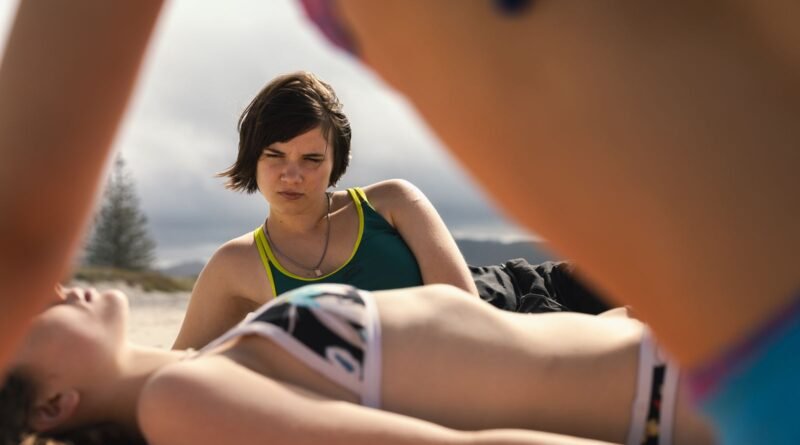
Big Girls Don’t Cry Interview: Paloma Schneideman & Ani Palmer on Growing Up and Finding Yourself
In our interview, Schneideman and Palmer open up about bringing the story to life, the importance of queer representation, understanding Sid’s complicated decisions, and why the struggles of growing up remain relatable across generations. They also share what they’d tell their younger selves and what going the extra mile means to them.
Watch our full interview below, or read the conversation as we dive into the making of Big Girls Don’t Cry.
TEM (The Extra Mile): Why was it important for you to tell this story during that particular time, especially since teenagers today are growing up in such a different world?
Paloma: It is different, but there are also those foundational things that stay the same. You’re always trying on different versions of yourself. You’re trying to be someone you’re not, doing that weird thing where you want to completely blend in and fit in, but also stand out and be noticed. The reason the 2000s were important was partly because that’s when I grew up, so it’s very much ingrained in my memory. But also, New Zealand in the 2000s was going through a cultural coming-of-age with the internet, cable TV and reality TV. It felt like a great way to mirror the big changes we go through as teenagers.
TEM: Ani, when you were preparing for the role, what helped you understand Sid’s need for validation, especially when she was making decisions that were hurting herself and others?
Ani Palmer: I mean I really related to Sid and her desperation to be seen, accepted and part of something. But I think the biggest thing that made me have empathy for her was seeing so many similarities between Sid and my younger sister, Sage. Even the name Sid was a nickname I used to call my younger sister! Straight away, I had this protective feeling towards her. In my eyes, she could do no wrong because she reminded me so much of my sister. You can make mistakes, but I’m still going to love you. I carried that feeling throughout the whole film and always wanted to approach the character with understanding and no judgment.
TEM: How did you get involved with the film? How did the collaboration with Paloma come together?
Ani: I was really lucky to have a small agent at the time, whom I met through an acting workshop. She sent me the audition, and I’d never actually been in a film before. It was the first audition where I felt a really deep connection with the character. I just showed up and did my best, and I guess they liked me because they kept calling me back! It was funny because there would be really long gaps between callbacks. I’d think I hadn’t gotten the role, and then on a random Tuesday, they’d call and ask me to come back again.
TEM: Paloma, how important was it to show that discovering your sexuality can simply be part of growing up?
Paloma : It was super important. My guiding compass for this film was making something that would have helped me when I was that age. Being a teenager back then, I felt so lonely. You’re pushing down all this shame around desire and identity, and there’s no one to talk to about it. When I got older and started talking about that time with friends and people in my community, we realized we’d all had similar experiences. That’s when I realized how much comfort a film like this could give. The discomfort leads to comfort because it’s not an easy watch. But I think there’s bravery in talking about things we don’t normally talk about. How else are we going to find the language for those experiences? It’s almost like exposure therapy.
TEM: Ani, how did you approach showing that vulnerability without judging the choices Sid makes?
Ani : During the rehearsal process, Paloma and I did a lot of journaling and discussing the character and her motivations. I never judged Sid for any of her decisions because she’s 14. You can’t really judge someone who’s just trying their best. I approached everything with a lot of empathy. During rehearsals, we didn’t really touch the script. We focused on understanding what was happening with Sid, the time period and her relationships with the other characters.
TEM: How much freedom did you have to bring your own instincts and personality into Sid?
Ani: I actually felt quite a shift in my own personality while working on Sid. She almost unlocked this playful, more innocent, younger side of myself, which was really cool. And I still carry that with me today. I brought a lot of myself into her, including small mannerisms. But Sid still feels separate from me. I remember watching the film for the first time, and it didn’t even feel like I was watching myself. That was a really strange experience!
TEM: Paloma, if you could go back and tell your 14-year-old self one thing, what would it be?
Paloma : It’d be like it’s going to be okay, and none of this matters. When you’re a teenager, all you know is your own little world. That’s your entire context for suffering. But then you grow up, you find your people and you find where you fit in. You just have to hang in there because it really is going to be okay
Ani: . You’re going to become exactly who you want to be. And those people you’re so worried about? They don’t matter.
TEM: If you could summarize the film in one word, what would it be?
Ani : “Wouch.” Like wow and ouch combined into one word!
Paloma: I’m putting a hyphen in mine so it still counts as one word: “Growing-pains.”
TEM: We’re all about going the extra mile. What does going the extra mile mean to you, and how do you apply that approach to your life?
Paloma : I think you just have to be brave. Going the extra mile is about remembering that tomorrow isn’t promised. Just be brave and be kind. That’s really it.
Ani : I think it’s about following what brings you fulfillment.Life is short, so do as much as you can to live the life you want. Don’t worry so much about what other people think. Just do what you know you need to do for yourself and your life.
Watch the trailer for Big Girls Don’t Cry below
Big Girls Don’t Cry hits Select Theaters October 9, 2026